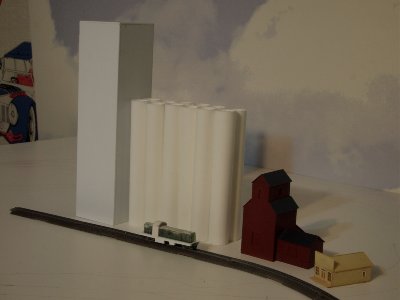
I've spent a couple more hours here and there working in the elevator project and I think its starting to look like the real thing. It's all styrene sheet, strip and tubing. The head house tower stands 135mm tall thats about 200' scale feet to give an idea of the size.
Monday, January 31, 2011
Saturday, January 29, 2011
just for fun (part 2)
Did you guess what it was?
Given my location in the USA it was probably pretty easy to work out that it would be a large concrete grain elevator. This one in Red Wing, MN to be exact. The real thing is about 200' tall so should present a pretty impressive model even in T scale. I've made a start.
Here, just for fun is a picture to give you an idea of the size of the structure. In this picture you can see, from right to left: A kit of a US false front store made last year. Next to that is my rural wooden grain elevator from last year also. Then next to that is the progress on the Red Wing elevator. On the track in front is the ongoing RS-1 model if you can't see it.
Thursday, January 27, 2011
Everything in Moderation
Earlier this week I was approached by T scale pioneer David K Smith owner of T-gauge.net and asked if I would consider becoming co-moderator of the Talking T gauge forum. As T scale grows in popularity and the forum membership grows he finds himself with less time time to watch over the forum. Not there is much to do. It is one of the most well behaved forums on the internet.
I was honoured to be asked. I'll see you over there.
Oh and behave yourself... :-)
Just for fun
Last night I embarked on a new T scale structure modelling project. I'm not going to tell you what it is yet.
All I will say is it is using three unopened packets of 12.7mm diameter evergreen styrene tube for starters.
In the words of the immortal Rolf Harris.
"Can you guess what it is yet?"
Monday, January 24, 2011
Wither Japan?
The world of scratchbuilding in T scale has been on fire over the past few weeks. This weekend particularly so. Not only was there my Alco RS-1 project underway. But there was also (are you ready for this list?)
A Fairbanks Morse H24-66
A Stanier Jubilee class steam locomotive
Experiments with T scale British outline tank engines (yes, engines two of them...)
A Finnish class SR1 o/h electric locomotive
I did also make a start on my Geep Project but got carried away with the Alco.
In addition to this there is some very impressive 3-D modelling being done for a British Railways Class 42 Diesel hydraulic loco project.
You have to be impressed. I know I am. The enthusiasm and abilities of all T scalers never seems to amaze me. I'm proud to be associated with all of them.
But like the title of this post says. Wither Japan? What are they doing in T scale? All the projects outline above are taking place in the US, Canada and Europe.
What are Japanese T scalers doing? I and many other T scalers would love to know.
Sunday, January 23, 2011
Hankyu chassis mods
The key to the RS-1 (and indeed my up coming Geep) model is being able to place a shorter body on top of the boxy chassis. A couple of simple cuts make this possible. It is something that even the most hamfisted modeller could do.
The H9000 chassis has a pair of locating pins on one end that engage into a pair of holes on the car body. At the other end the electrical contact strip folds down to make contact with terminals on the LED's that illuminate with the direction of travel. It is simplicity itself to slice the locating pins off with a sharp modelling knife and cut the folded down pieces of contact strip off with a track cutting disc and then slice of a couple of plastic ribs behind them with yuor modelling knife. Doing this you can shorten a body by approaching 6mm or about 9 scale feet.
Above: Finished chassis with pins and contact strip cut off.
Alco RS-1
So, with my rediscovered enthusiasm brimming I set about on a construction project. Not the Geep I thought I might do. But an Alco RS-1. There are many pictures of the class in Don Hofsommers book on the Minneapolis and St. Louis Railroad and plans are easy to hand in the internet so I was well sorted with reference materials.
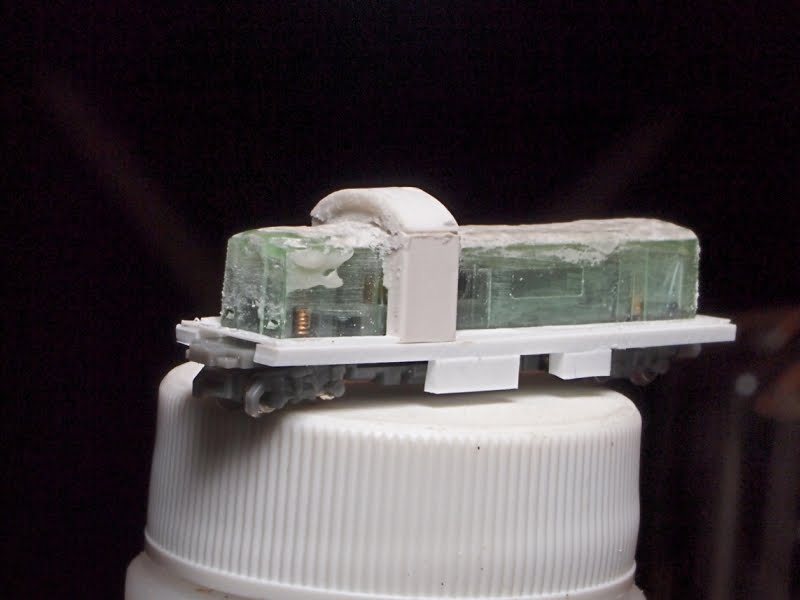
For the project I chose to covert a Hankyu 9000 power car. I had a "kitbashers set" that I had bought from Train Aids A quite a while ago. They sell units specifically for the crazy kitbashers in the T scale world who want to scratchbuild. Yes the loco will be a bit oversize and the bogies will be in the wrong place. But even in the early days of HO, N and Z there were models around that were not scale reproductions of the real thing. So as long as this looked like an RS-1 and folks recognised it as such then that was fine by me.
Above: The first task was to shorten the passenger car body. About 6mm was cut out of it to get closer to scale length. I also filed off some of the details on the bodywork along the way.
Above: Next came the addition of the cab. The sides were represented by some lengths of 4.5mm x 1.5mm evergreen strip and the distinctive roof profile was cut out of a section of 12.5 mm evergreen styrene tubing.
Above: The next task was to set about the body with some filler putty, filling in the cab and the roof to change that to a better profile. The final piece of work for the day was to add the walkway around the side and a little below floor detailing, representing fuel tanks, to hide the Eishindo chassis.So far, so good. I'm pretty pleased with it. It has already been recognised as an RS-1 on Talking T Gauge so my aim has been achieved. The next task will be to give it a light coating of primer so I can see just how it really looks.
Subscribe to:
Posts (Atom)